
What if the hundreds of pounds you’ve spent on an EGR solution garages across the North East usually suggest were actually just a temporary sticking plaster for a deeper software conflict? Most drivers in the North East know the sinking feeling of an unexpected “limp mode” during a busy commute. You’ve likely been told that a costly mechanical replacement is the only way forward, even after previous cleanings failed to stop carbon from clogging the system again.
In this article, you’ll learn how to spot the early warning signs of a failing valve and why professional software recalibration is the most reliable fix. We’ll break down the symptoms of failure, the pitfalls of traditional repairs, and how Naked Frog Vehicle Tuning’s specialist mobile service can restore your engine’s smoothness, performance, and efficiency whilst you’re at home or work.
Key Takeaways
- Identify the critical warning signs of a failing EGR valve, from erratic engine behaviour and rough idling to the sudden onset of protective limp mode.
- Understand why traditional mechanical cleaning and expensive part replacements often result in recurring faults by failing to address the underlying software instructions.
- Discover how a professional EGR solution Sunderland drivers can access at their doorstep provides a permanent recalibration of the engine control unit.
- Experience the convenience of a specialist mobile service that restores your vehicle’s smoothness and performance whilst you remain at home or work.
Recognising the Warning Signs: Common EGR Valve Symptoms for Sunderland Drivers
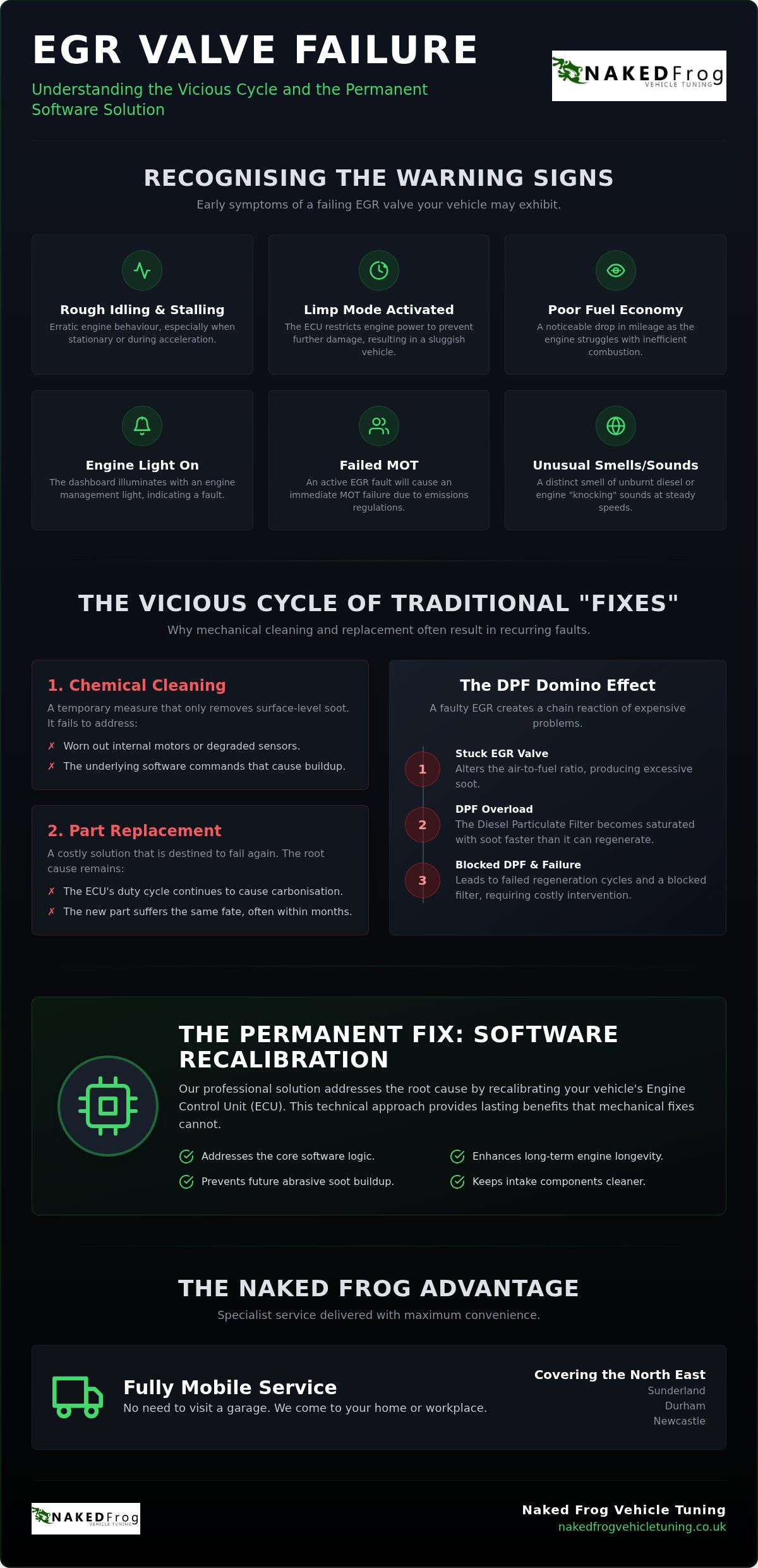
Identifying a failing Exhaust Gas Recirculation (EGR) valve early can save you from an expensive breakdown on the A19 or a stressful commute through the city centre. When the system begins to struggle, the engine’s behaviour becomes erratic. You might notice a rough idle while waiting at junctions, a frustrating hesitance when you try to accelerate, or even frequent stalling. These aren’t just minor annoyances; they’re clear signals that your vehicle’s breathing is compromised.
As the fault progresses, the Engine Control Unit (ECU) may trigger “limp mode.” This safety feature restricts engine power to protect the engine from further soot accumulation, often leaving you with a sluggish, underpowered car. Other red flags include:
- A noticeable drop in fuel economy as the engine struggles to maintain efficient combustion.
- A distinct smell of unburnt diesel or “knocking” sounds whilst cruising at steady speeds.
- An illuminated engine management light on the dashboard, often accompanied by fault codes related to flow or position.
If you’re experiencing these issues, seeking a professional EGR solution Sunderland specialist is the most efficient way to restore your vehicle’s reliability and smoothness. Our mobile service provides a tailored EGR solution Sunderland drivers can rely on to clear these faults permanently without the need for mechanical wrench-work.
The Role of Carbonisation in Modern Diesel Engines
The primary culprit behind these failures is carbonisation. This process involves the gradual accumulation of soot within the valve, which eventually causes the mechanical solenoid to stick in a fixed position. Whilst motorway driving helps burn off some of these deposits, short, low-speed journeys around Sunderland and Newcastle accelerate the buildup. Without the heat generated by long-distance travel, the soot hardens into a thick crust that no amount of chemical cleaning can easily resolve. This mechanical blockage forces the ECU to compensate, leading to the performance degradation and “limp mode” errors many local drivers face.
The Vicious Cycle: Why Cleaning and Replacement Often Fail
Many drivers initially opt for chemical cleaning, but whilst this removes surface soot, it cannot repair a failing internal motor or a degraded sensor. These electronic components often wear out due to the constant strain of operating in a carbon-heavy environment. Similarly, fitting a new mechanical valve frequently proves to be a short-term fix. If the underlying software-driven duty cycle remains unchanged, your new component will likely succumb to the same carbon buildup within months, especially if your driving involves frequent urban stops around the North East. This creates a cycle of repetitive spending on parts that are destined to fail again because the root cause hasn’t been addressed.
A faulty EGR valve doesn’t just affect engine performance; it creates a dangerous domino effect for your Diesel Particulate Filter (DPF). When the valve sticks, it alters the air-to-fuel ratio, producing excessive soot that quickly saturates the DPF. This leads to frequent, failed regeneration cycles and eventually, a blocked filter that requires even more expensive intervention. If you’re tired of the “clean and repeat” cycle, exploring a professional EGR solution Sunderland drivers trust can break this technical deadlock.
Impact on DPF Health and MOT Readiness in 2026
Current MOT standards are incredibly strict. An active Engine Management Light triggered by an EGR fault results in an immediate failure. By choosing a specialist EGR solution Sunderland service, you ensure long-term emissions stability and protect your DPF from premature failure. This technical recalibration moves beyond temporary cleaning to provide a permanent, software-based fix for modern engine management issues.
Professional EGR Software Solutions: The Permanent Fix in the North East
Professional software recalibration moves beyond the limitations of physical parts by addressing the digital logic that controls the system. Our professional EGR solution Sunderland service involves a sophisticated recalibration of your Engine Control Unit (ECU) instructions. By precisely adjusting how the valve operates, we prevent abrasive soot from recirculating through your intake manifold and into the combustion chamber. This technical approach doesn’t just clear fault codes; it enhances engine longevity by keeping the internal components significantly cleaner for longer and preventing the build-up of sludge in the intake.
One of the greatest advantages of our approach is the fully mobile service we provide. If your vehicle is currently stuck in limp mode or you simply can’t spare the time to visit a garage, we come directly to your home or workplace in Sunderland, Durham, or Newcastle. This eliminates the stress of arranging recovery or losing a day of work to a corporate garage. You get a bespoke, expert-level repair delivered with the convenience of a local specialist who understands the North East roads and the specific needs of modern diesel drivers.
Combining Emissions Fixes with a Stage 1 Performance Remap
We can optimise your vehicle even further by pairing your EGR solution with a Stage 1 Performance Remap. This combination transforms the driving experience entirely. You’ll enjoy smoother power delivery, increased torque for easier overtaking, and the total elimination of those frustrating dashboard warning lights. It’s an upgrade that turns a necessary repair into a genuine performance transformation. Ready to restore your car’s true potential? Book your mobile diagnostic and software tuning session through our website today to experience a tailored EGR solution Sunderland drivers can trust for long-term reliability.
Restore Your Vehicle’s Performance and Reliability
Living with a sluggish engine or the constant threat of limp mode is frustrating and unnecessary. By moving beyond the temporary fixes of chemical cleaning and expensive mechanical replacements, you break the cycle of carbonisation that plagues modern diesel engines. A professional EGR solution Sunderland provides a permanent software-based recalibration that protects your DPF and restores the smooth, responsive power delivery you expect from your car. Our 5-star rated local specialist team brings enthusiast-level expertise directly to your doorstep, ensuring your vehicle is treated with technical precision without you ever needing to visit a corporate garage.
Don’t let emissions faults dictate your commute or compromise your engine’s longevity. Whether you’re at home or work, our fully mobile service across Sunderland, Durham, and Newcastle is ready to transform your driving experience. Book your mobile EGR diagnostic and software solution today and get back on the road with total confidence.
Frequently Asked Questions
Can I still drive my car with a faulty EGR valve in Sunderland?
You can drive your vehicle, but it isn’t recommended for long periods. A sticking valve often triggers limp mode, which restricts power and makes navigating Sunderland city centre traffic difficult. Continued use also accelerates soot buildup in the Diesel Particulate Filter. Resolving the issue quickly prevents secondary damage to expensive exhaust components and ensures your car remains reliable for daily commutes.
Will an EGR software solution cause my vehicle to fail its MOT in 2026?
A professional software recalibration helps you pass by clearing the Engine Management Light, which is an automatic MOT failure. As of 2026, smoke opacity standards for diesel vehicles remain strict. Our specialist software approach ensures the vehicle operates efficiently without triggering dashboard warnings. You must keep the physical valve in place to satisfy visual inspection requirements during the test.
How much does it cost to fix EGR valve symptoms in the North East?
Costs vary depending on the chosen method. Professional mechanical cleaning in the UK often ranges between £80 and £250, whilst a full valve replacement can average up to £372 or more at main dealers. Choosing a permanent EGR solution Sunderland drivers can access via software often provides better value by preventing the need for recurring and expensive mechanical repairs.
Is a software solution better than physically cleaning the EGR valve?
Software is often superior because it addresses the underlying command logic rather than just the surface soot. Physical cleaning is a temporary fix that doesn’t repair failing internal sensors or worn motors. By recalibrating the ECU, you provide a permanent EGR solution Sunderland vehicles need to stop the cycle of carbonisation. This approach ensures long-term smoothness and prevents the valve from sticking again.